


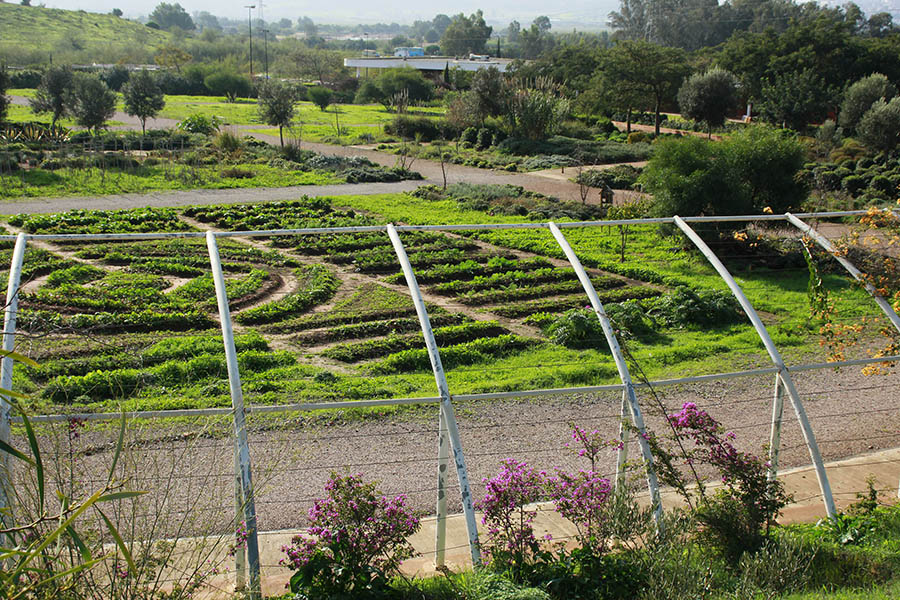
And unlike other years, because this year the rain has been extremely generous and has quenched the thirst that had built up over decades. The thirst of the soil, the plants and the animals. This climatic phenomenon has brought relief and happiness to human beings and to all living creatures. And this is true throughout Morocco, as well as in the Rabat and Salé region. In spring, flowers have blanketed the meadows, filling them with colours and textures. Glebionis coronaria reaching heights of two metres, mallows (Malva sp.) of various species, with delicate shades, Anchura azurea blanketing the hills in cobalt blue, sparkling poppies of a deep red everywhere… A veritable festival of botanical splendour that has delighted the senses and adorned fields and gardens. And all of this dotted with swarms of birds and fluttering butterflies: Colias croceus, Papilio machaon, Vanessa cardui and other springtime beauties have been more abundant than ever this year at the Med-O-Med School of Gardening. The best indicator of the area’s environmental quality.
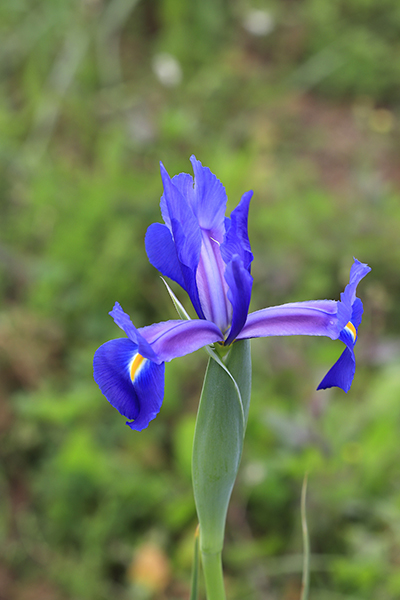
A weather phenomenon that brought great joy, above all, to farmers and gardeners, but which, in the case of the school, meant that lessons had to be slightly adjusted and pupils had to take shelter in classrooms and other facilities to protect themselves from the downpours.
This year, the rain has been extremely plentiful and has quenched the thirst that had built up over decades – the thirst of the soil, the plants and the animals.
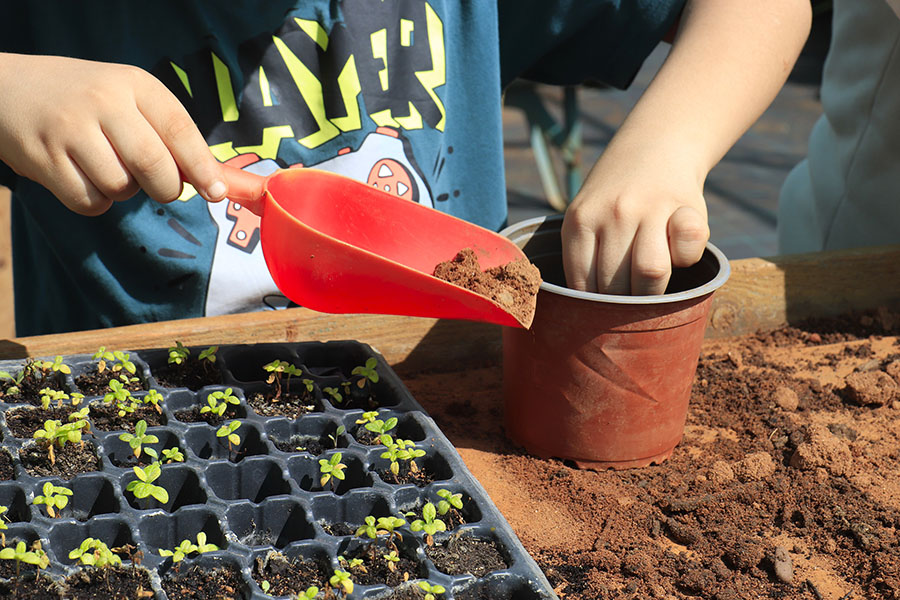
Although the training provided by the centre, as an apprenticeship-based training centre, consists of 20% theory and 80% practical work — which takes place within the park’s eight hectares and, on occasion, outside it — the trainers have had to adapt the programmes to account for the numerous rainy days, organising alternative activities. Herbarium work, sorting seeds from the nursery, learning to use and understand tools and machinery, theory lessons and team-building games to foster team spirit amongst the young people.
Training
During this academic year, training in environmental education has been stepped up for the trainers — specifically, Jihane Elmbarki and Abdellatif Sasy, under the supervision of the educationalist Adnane Boujmal — but it has also been provided to a group of young trainees who have benefited from it. There is high demand for environmental awareness in Morocco, and this provides an excellent boost to their future employability as youth workers, as is already the case for some of them. The numerous school visits the centre receives, accompanied by themed workshops tailored to different age groups and led by our instructors, also provide an excellent opportunity for young pupils to reconnect with nature and engage with the local landscape and biodiversity.
Furthermore, in order to complement their training in a fun way and break up the monotony, the trainees had the opportunity to go on several visits and excursions that enabled them to familiarise themselves with the gardening trade and Morocco’s plant diversity: the Mamoora cork oak forest, the Arborescence nursery, the Rabat Experimental Garden and the Meknes International Agricultural Fair.
The trainers had to adapt the programmes to cope with the numerous rainy days, organising alternative activities. These included herbarium work, sorting seeds from the nursery, learning how to use tools and machinery, theory lessons and team-building games to foster a sense of team spirit amongst the young people.
They have also taken part in gardening projects commissioned from the school by various clients. These included a fruit tree pruning session led by Mr Mustapha Belharcha; the creation of a beautiful courtyard garden in Rabat, dotted with Andalusian-style planters and coordinated by Mr Lahcen Chakik and Mr Aissam Fahmi; a collective initiative to renovate the green spaces at the transport company Alsa — a key partner of the School of Horticulture — and a project in the garden of ANAPEC (National Agency for the Promotion of Employment and Skills). These external activities provide an excellent opportunity to strengthen not only their knowledge but also their self-confidence.
The trainees had the opportunity to go on a number of visits and excursions, which enabled them to familiarise themselves with the art of gardening and Morocco’s plant diversity.
Furthermore, the school has introduced a work-based learning programme for third-year students during their final term, with the aim of familiarising them with the workplace. A number of partnerships have been established with companies in the sector, enabling students not only to complete their training but also to ease their social and family circumstances thanks to a small stipend.
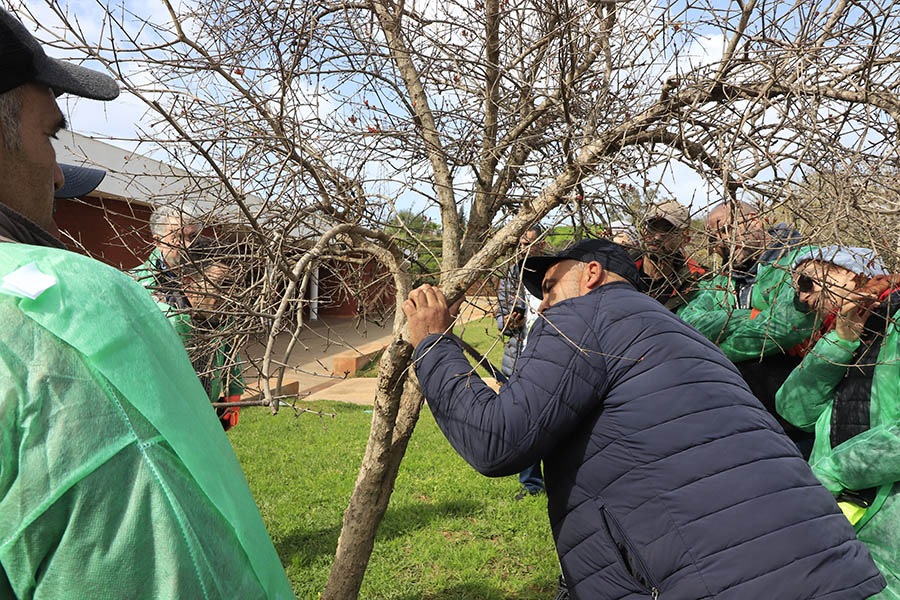
As for the training courses for professionals in the sector, delivered by the school’s trainers, these have seen a significant surge in popularity this year and have enabled numerous gardeners and private individuals to deepen their knowledge, helping them to obtain a training certificate.
What’s new
A number of changes have been made during this academic year, which are always necessary in regenerative, evolving and resilient projects such as this one. Abdellatif Sasy and Fouad Baiza, former students from the first intake, have – after several years working at the school as training assistants – become trainers themselves and are jointly responsible for the first training course (CAP), which they deliver with imagination, dedication and expertise. This is a source of great satisfaction for the Med-O-Med family, which has been made up of the school’s team for eight years now.
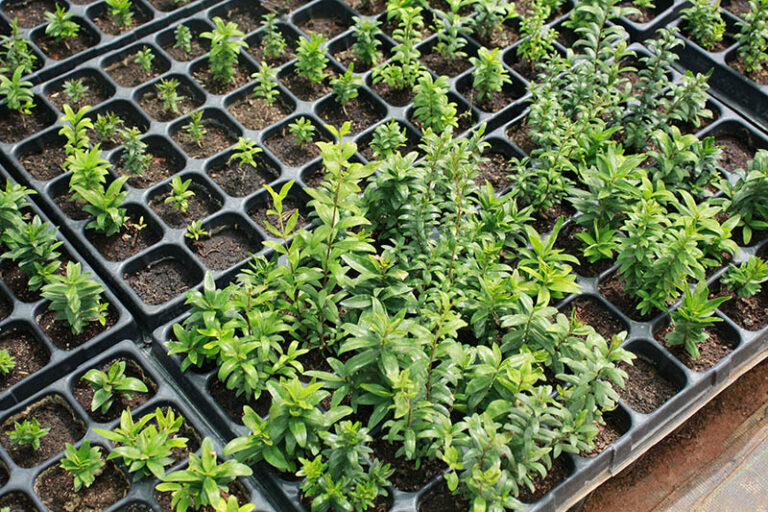
The school’s nursery, which also forms part of the curriculum and where young people learn the art of plant propagation and cultivation, is also running smoothly. In order to organise the work more effectively, a seed bank containing native, ornamental and edible seeds has been set up this year in a structured and practical manner. Furthermore, the small collection of endemic bulbs donated by Professor Fakir and other volunteers (Iris planifolia, Iris tingitana, Narcissus tazetta, etc.) is in excellent condition and we have been able to collect their seeds.
The school has introduced a work-based learning programme for third-year students in their final term, to enable them to familiarise themselves with the workplace.
Alongside ornamental species, there are endemic and native plants, which are better adapted to current climatic conditions and for which demand is growing amongst landscape architects who recognise the need to shift gardening paradigms towards more resilient and environmentally friendly models. Cistus sp., Pistacia atlantica, Chamaerops sp., Argania spinosa and Tetraclinis articulata, amongst many others, are available to private individuals and industry professionals who wish to enrich the plant diversity of their green spaces whilst preserving Morocco’s rich biodiversity.
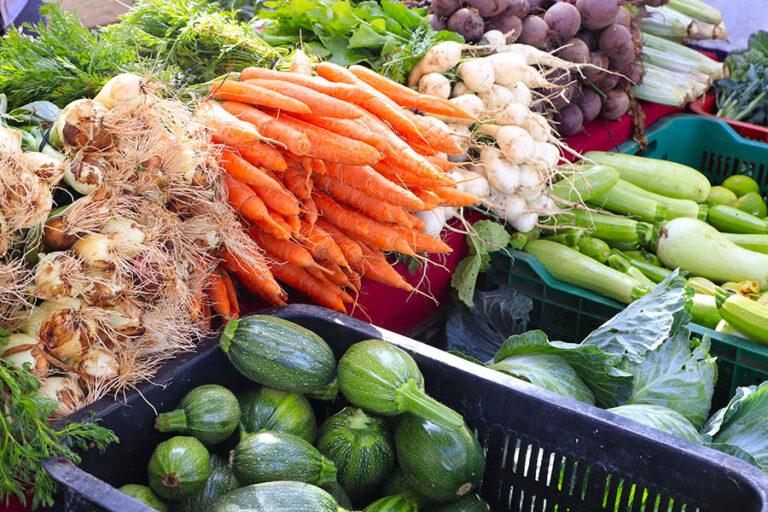
As it does every year, the winter educational vegetable garden has provided a varied selection of seasonal vegetables. In fact, for the first time, these have been sold at the weekly organic market, which is held to raise funds for the project’s running costs, enriching the market with their range of colours and flavours and enabling the learners to develop social skills. Meanwhile, the summer vegetable garden offers lettuce, courgettes, peppers and chives, and is, above all, waiting for the numerous varieties of tomatoes – in every shape and shade imaginable – to ripen.
Environmental awareness
With regard to promoting species better adapted to climate change, a catalogue of the plants grown at the school has been published. Furthermore, awareness campaigns have been launched with the aim of publicising the produce and boosting sales as a revenue-generating activity. On 17 May 2026, an exhibition of plants from the nursery was organised; it was a great success and has since become a permanent exhibition to make the produce more accessible to customers. Visitors take the opportunity to recharge their batteries in the pleasant shade of the pergola and the coolness of the greenery, which lends a sense of tranquillity to the space. At the same time, a large market featuring food, cosmetics and handicrafts was held, in collaboration with M & N Events, to round off a lively and cheerful weekend.
Siempre con el objetivo de fomentar la sensibilización medioambiental, el 21 de mayo tuvo lugar la presentación del libro «Paysages en partages» (trad. Paisajes compartidos), de los paisajistas franceses afincados en Marruecos Frédérique Levesque y Philippe Vidal, seguida de una mesa redonda en la que también participó el arquitecto Luís Arleo, en torno a la situación y los retos que plantean hoy en día los paisajes de Marruecos. Por su parte, el sociólogo y político monegasco Daniel Boéri presentó su libro «La planète a besoin de nous» (trad. El planeta nos necesita), un llamamiento a la toma de conciencia y a las acciones necesarias para luchar contra las emergencias climáticas planetarias.
With the aim of promoting environmental awareness, the book launch for “Paysages en partages” (translated as ‘Shared Landscapes’), by the French landscape architects based in Morocco, Frédérique Levesque and Philippe Vidal, followed by a round-table discussion – in which the architect Luís Arleo also took part – on the current situation and challenges facing Morocco’s landscapes today. Meanwhile, the Monegasque sociologist and politician Daniel Boéri presented his book “La planète a besoin de nous” (translated as ‘The Planet Needs Us’), a call for awareness and the action needed to combat global climate emergencies.
Colaborations
But the gardening school would not be what it is without the help of numerous friends and partners. Trusted friends who lend us a hand with matters relating to communication, legislation or fundraising, drawing on their extensive experience and guided by their hearts… and partners who make their expertise in soft skills available to the students, providing them with the tools to successfully secure future employment and achieve social inclusion. In this regard, the Belgian association Echos Communication has been supporting them for many years on their journey towards independence and dignity.
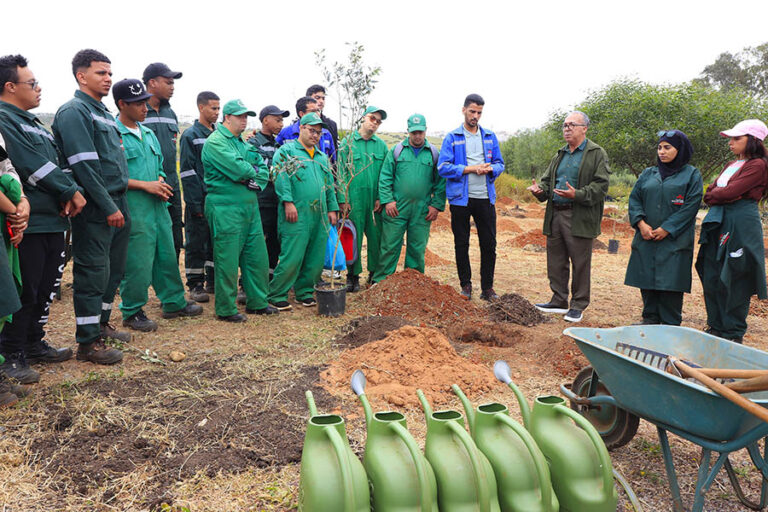
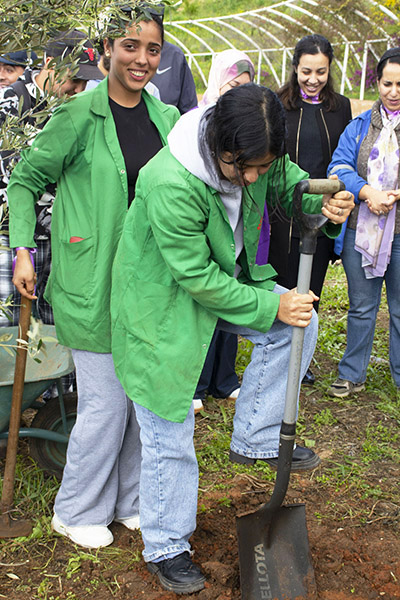
This year, 2026, has been particularly fruitful – and never has that been more apt – thanks to the agreement established between the horticultural college and the High Atlas Foundation, a Marrakech-based foundation working to promote the production of Moroccan fruit trees for the benefit of rural communities across the country. A community planting event was therefore organised at the school, involving students, technicians from the HAF and the horticultural school, as well as several volunteers. It was an enjoyable day spent together, dedicated to planting olive, pomegranate, fig, carob and argan trees, sourced from the HAF’s nurseries and the school’s own nurseries.
Furthermore, as part of these enriching collaborations, several visits and exchanges have taken place between the horticultural college and the ENA (National School of Agriculture) in Meknes, at the premises of both training centres, in both Salé and Meknes. Furthermore, we had the pleasure of welcoming the Minister for Economic Inclusion, Small Businesses, Employment and Skills — the department responsible for this project — Mr Younes Sekkouri, as well as Ms Naima Ben Yahya, Minister for Solidarity, Social Inclusion and the Family, who was very impressed by the work carried out at the training centre.
Professional integration
But all this would be in vain if our students were unable to secure future employment; however, this year, numerous companies and individuals have approached us seeking interns or graduates to offer them job opportunities. From the Majorelle Garden, one of our most generous and committed partners, to Végétal Concept, Green Expert, Somecotrad, Tamesna, Atelier Vert and Les Jardins du Pacha, many young people have been formally employed. This is particularly true of Nassima and Malak, who, supported by our employment support officer, Hahane Elmadihi, have secured very suitable jobs in Marrakech maintaining a hotel garden, and regularly send us photos that fill us with joy.
But all this would be in vain if our students were unable to secure future employment.
Thank you once again to all our partners and friends. To the companies that provide young people with employment under good conditions and, of course, to our funders: the INDH, the Rabat-Salé-Kenitra Regional Council, the UNDP, the Drosos Foundation, the Spanish Agency for International Development Cooperation (AECID), the Chinese Embassy in Morocco, the transport company ALSA Morocco, and all the institutions that have supported and backed us over the years – years that have been very demanding but immensely rewarding from a human perspective.
Text and images: Inés Eléxpuru
Cet article est disponible en français.
This post is available in: