


At the Bouregreg Med-O-Med Gardening School, we teach ecological gardening and farming practices that respect life. Natural fertilisers made from compost produced on site using green waste, sheep manure and mulch to prevent evaporation and soil mineralisation… creating living soil, but also using natural plant protection treatments when necessary.
But the choice of botanical species is also very important in this regard, which is why priority is given to hardy species, preferably Mediterranean ones, due to their lower water consumption. And what can we say about the native Moroccan plants that we grow in our nursery to promote regenerative gardening models adapted to local climatic conditions! A real treasure.

The way we irrigate is also crucial in an environment threatened by water stress, and to this end we make sensible use of well water which, being somewhat brackish due to its proximity to the Bouregreg estuary, is subsequently desalinated using a reverse osmosis system.
Biodiversity, not only plant life but also animal life, thrives in the eight hectares of the park.
As a result, biodiversity, not only plant life but also animal life, thrives in the park’s eight hectares. Amphibians, reptiles, birds (many species of birds, some of which, such as the common kestrel, nest among us) and many others.
Insects
But let us pause for a moment to consider insects, those marvellous invertebrates with compound eyes, antennae and often beautiful wings, of which 1,300,000 species have been catalogued and around 10,000 new ones are recorded every year. They represent 55% of species biodiversity and 85% of animal biodiversity on the planet. It is estimated that there are between 5 and 80 million species. An incredible wealth, but a very fragile one (40% of insects are endangered), which humans often reject, far from appreciating and admiring their beauty.

They are the oldest animals in terms of their adaptation to the earth, and the first to have the ability to fly and move through the air. While it is true that some clearly compete with humans, such as agricultural pests, and others, generally found in anthropogenic environments, are vectors of disease and nuisance, a large number of them have the extraordinary gift of pollinating plants cultivated by humans, becoming their best allies. In particular, hymenoptera (bees, wasps, etc.), diptera (mosquitoes), coleoptera (beetles) and lepidoptera (butterflies).
Butterflies, a little gem
Without a doubt, one of the most colourful, fragile and volatile insects, never better said, are butterflies, which reign supreme in the school park and represent the joy of spring with their fluttering wings.

After mating and laying eggs, caterpillars are born, sometimes magnificent ones, as in the case of the monarch butterfly (Danaus plexippus) and Papilio machaon, which, after feeding abundantly, will form the chrysalis that will give life to the new butterfly, thus completing the cycle of metamorphosis.
Without a doubt, one of the most colourful, fragile and volatile insects, never better said, are butterflies, which reign supreme in the school park and represent the joy of spring with their fluttering wings.
Butterflies and moths are among the most endangered animal species and insects in the world. This is due to poaching, the loss of their natural habitats and the use of pesticides in intensive agriculture. This is particularly noticeable, for example, in monarch butterflies, whose forest hibernation areas in Mexico are declining at an alarming rate.
This extraordinary butterfly, which twice a year migrates 4,023 kilometres across the continent between its summer and winter habitats, has declined by between 23% and 72% in the last ten years, according to the IUCN (International Union for Conservation of Nature).

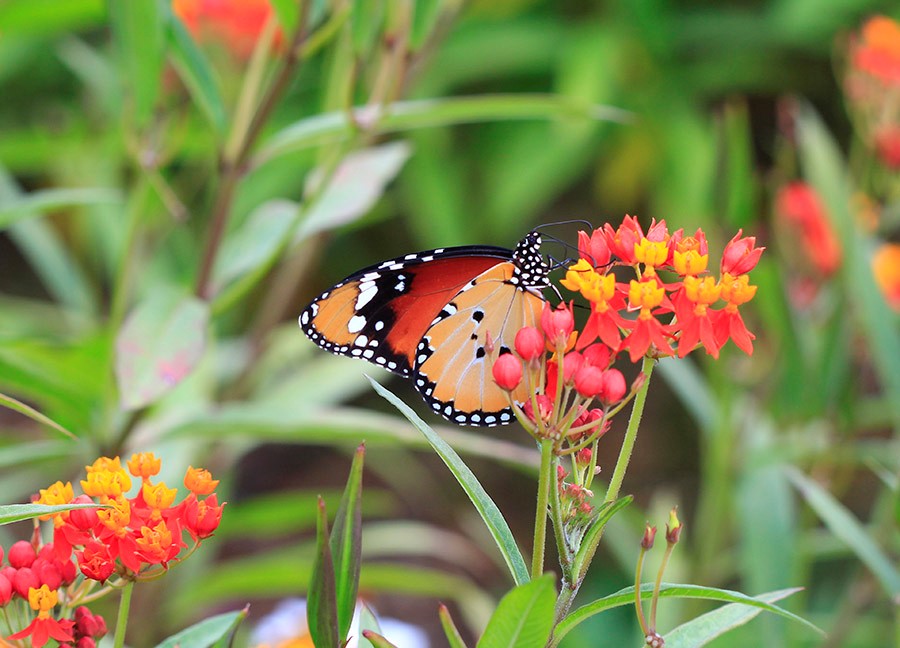
It is now stable in the coastal regions of Morocco, where it has been adopted (it is not native) and forms permanent colonies. However, like the magnificent Iphiclides feisthamelii, once very abundant and native to the Mediterranean region, the monarch butterfly and its cousin, the small monarch (Danaus chrysippus), are also in decline in Morocco.
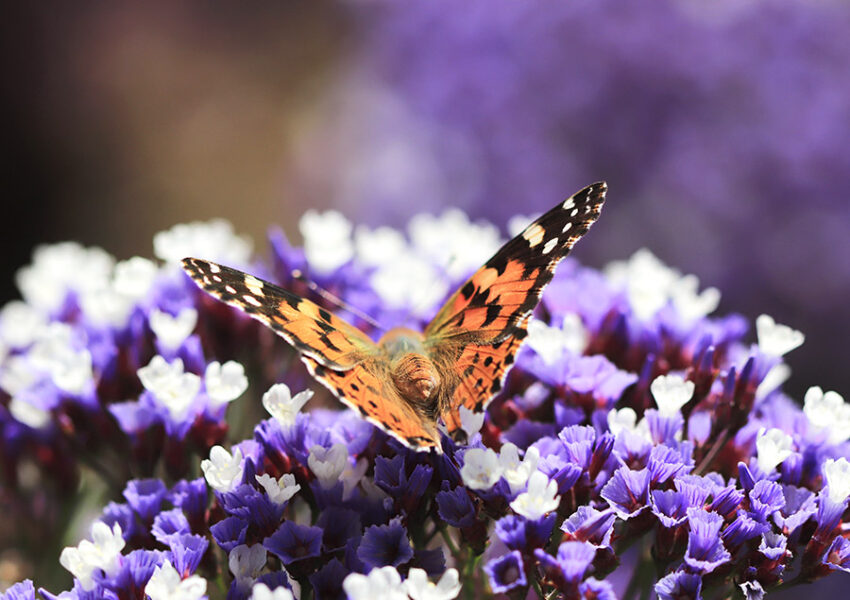
At school, we strive to encourage the reproduction of monarch butterflies by sowing and planting their host plant, Asclepias curassavica, every year. We do the same with Papilio machaon, which loves fennel, and other species that delight in Limonium perezii, an ornamental plant with mauve flowers that is very abundant in our area. Limonium is one of the favourite species of butterflies in general. You can see Vanessa cardui (in the cover photo), Vanessa atalanta, Pieris rapae and many other little gems feeding on it.
Text and photos: Inés Eléxpuru
Cet article est disponible en français.
This post is available in: