


El Robledo Garden, RABJEN, Spain
- NAME El Robledo Botanical Garden
- WEBSITE http://www.juntadeandalucia.es/medioambiente/servtc5/ventana/mos
- EMAIL jbotanico.robledo.cmaot@juntadeandalucia.es
- PHONE (+34) 671 56 86 59
- OPENING HOURS Tuesday to Friday from 10:00 a.m. to 2:00 p.m.
Saturdays and Sundays from 10:00 a.m. to 2:00 p.m.
Closed on Mondays. - OWNERSHIP Public institution. Consejería de Medio Ambiente y Ordenación del Territorio (CMAOT).
- DIRECTOR Carmen Rodriguez Hiraldo
- FACILITIES The infrastructure associated with the garden includes: a classroom/workshop, restrooms, a gardening storage area, a shade house, a laboratory, an information point, and an office that is part of the Sierra Norte de Sevilla Natural Park offices.
- AREA (IN SQM) –
- NUMBER OF SPECIES 362
- CONSERVATION PROGRAMMES
-
- Location and monitoring of protected, endangered, endemic, and rare flora and fungi taxa present in Andalusia.
-
- Collection of seeds and other propagules from the taxa under study, intended for:
- Development of germination and establishment protocols.
- Representation in different botanical and mycological gardens.
- Conservation in the Andalusian Plant Germplasm Bank.
- Reintroduction or population reinforcement actions in the environment.
- Collection of seeds and other propagules from the taxa under study, intended for:
-
- Representation of the vegetation, flora, and mycoflora that characterize the various biogeographical sectors of Andalusia.
-
- Maintenance of conservation collections and genetic rescues.
-
- Participation in the development of Planes de Recuperación aprobados por la Consejería de Medio Ambiente y Ordenación del Territorio, in this case, two of the four plans currently approved: Pteridophytes and Dunas-Arenales.
- RESEARCH PROGRAMMES
- Collaboration with research centers, such as the CSIC, and universities, both regional and national, for the study of protected and endangered taxa present in the Andalusian community. The collections of botanical and mycological gardens are a tool for scientific research, as they provide genetic material from remote locations in the wild and bring together species in a single place for more effective research. Research centers such as the CSIC, other botanical gardens, private foundations, companies, and various universities rely on the equipment and resources offered by the Network to develop projects in different areas, including studies on pests, the effects of herbivory, trials with special substrates, and the monitoring of invasive alien species.
- Collaboration with the Sociedad Española de Biología de la Conservación de Plantas (SEBICOP) on the SEFA Project (Seguimiento de Especies de Flora Amenazadas y de Protección Especial en España), which consists of studying the status of 70 species listed in the annexes to the Directiva de Hábitats, the Catálogo Español, or the LESPRE.
- Permanent member of the Asociación Iberomacaronésica de Jardines Botánicos
- EDUCATION PROGRAMMES
1) The Aldea Program, a program developed in collaboration with the Consejería de Educación, whose goals are to promote the integrated development of educational initiatives for the conservation of natural resources and the promotion of sustainable development within the Andalusian educational community, with the aim of contributing to a more environmentally friendly, fair, and supportive society, enabling the achievement of a comprehensive education that shares and is based on the four educational pillars proposed by UNESCO: Learning to be / Learning to live together / Learning to know / Learning to do.
2) Training courses for professional sectors that require technical training in endangered and interesting flora.
3) Activities and workshops on different topics and at different levels aimed at all types of audiences as a way of introducing them to Andalusia’s floral values: workshops on photography, traditional uses of plants, knowledge of certain plant groups, etc.
4) Guided tours to learn about the contents of the different botanical gardens.
5) Permanent workshops with groups that can observe the dynamics of the gardens at different times of the year.
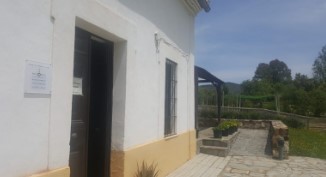 El Robledo Botanical Garden is located at the entrance to the Sierra Norte de Sevilla Natural Park, between the towns of Constantina and El Pedroso, next to the park’s visitor center.
This protected area, declared a Natural Park in 1989, occupies the central sector of the western Sierra Morena, in the north of the province of Seville. In September 2011, its incorporation into the European Geoparks Network was approved. It is one of the largest natural parks in Andalusia, covering 177,484 hectares, and among the park’s geological and landscape features are Las Cascadas de la Rivera and Cerro del Hierro, both declared Natural Monuments.
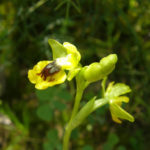
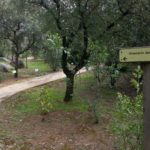
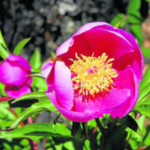
The flora and vegetation represented in the garden are characteristic of Mediterranean scrubland and pastureland. This vegetation is adapted to the summer drought, where rivers and streams are of great importance. Visitors will also find a collection of endemic species in the garden, including some that are exclusive to the Sierra Morena, such as foxglove. Finally, you can take a look at a traditional orchard from these mountains, with varieties of fruit and vegetables that can be grown in the region.
This post is available in: